|
The Millennium project is under maintenance and only Otterburn and Calton are available at present.
|
|||||
| Calton
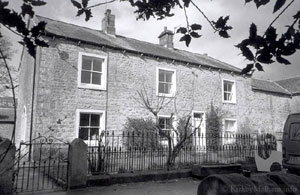
At the time of the Domesday survey in 1086 the village was stated to be part of the parish of Kirkby Malghdale, and referred to as Caltun, meaning Cold Town owing to its high and exposed position. The village was situated on the ancient market road from Ripon to Settle, and on the high ground ( 600ft ) to the east of the River Aire and a quarter of a mile from Airton. Calton village is a cul-de-sac having no church, shops, pub or telephone box. It does have a post box with a twice daily collection and a postal delivery at 7.30am. Calton also includes the small complex of Newfield Hall (with a small cottage behind usually used for the staff of Newfield Hall) and Newfield Grange which are situated half a mile from the village. Calton is chiefly memorable as the birthplace of Major General Lambert who “addisted himself to the cause of rebellion and bore perhaps a deeper part in the miseries of that unhappy period than any single person except Cromwell”. General Lambert was born at Calton Hall on 7th September 1619 and died in 1683 on Drake’s Island in Plymouth Sound after a very eventful life of power and influence. The village has grown considerably since 1984 when the estates of Jimmy and John Thompson made barns available for conversion to domestic dwellings. In the village itself there are seven barn conversions and one in the process of conversion. There are twenty dwellings of which eight are listed buildings. Calton is a thriving village and in recent years two young families have moved in bringing children with them, considerably lowering the age profile of the village. Otherwise there has been little movement in the last twelve years. In January 1969 there were twenty-one adults and seven children. In 1994 there were thirty-nine adults and thirteen children. In December 1999 there were approximately thirty-eight adults and sixteen children. In 1969 there were approximately nine cars, in 1994 this was thirty-two and in December 1999 there were thirty-one. |
|||||
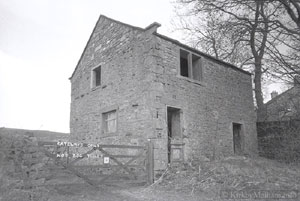 |
East Barn
The barn, which has planning permission for conversion to a dwelling, was part of Manor Farm and is still part of the estate of James (Jimmy) Thompson. Work was begun on the house with windows being inserted. Extensive work including the whole of the inside remains to be completed. |
||||
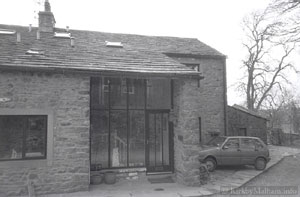 |
Foss Gill Cottage.
Attached to South Cottage and built in the 18th century. The whole building was originally a barn used by Manor Farm up to 1983 when it was sold as part of the estate of Jimmy Thompson. The barn was converted into two cottages in 1987 of which Foss Gill Cottage forms one half. The conversion was done by a builder called Mr Black. Foss Gill Cottage is currently lived in by Peter and Ann Dowdall. |
||||
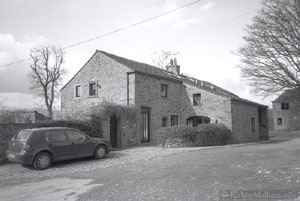 |
South Cottage.
Attached to Foss Gill Cottage and built in the 18th century. The whole building was originally a barn used by Manor Farm up to 1983. The barn was converted into two cottages in 1987 of which South Cottage forms one half. Currently lived in by Alan and Iris Mercer. |
||||
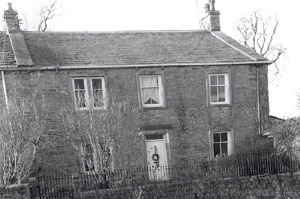 |
Manor Farm.
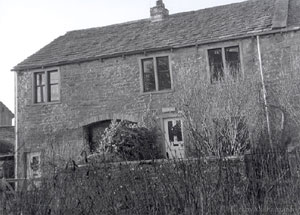
Built between 1750 and 1800 with the later addition of a barn or shippon now converted to dwelling and called Manor Barn. The building, which is grade ii listed, is of slobbered rubble construction with a slate roof. Windows are a mixture of mullioned and late 19th century sashes. It is the former farmhouse of Manor Farm which was last farmed in the early 1980s by James (Jimmy) Thompson. Interesting internal features include a cellar, archways in the top hall and old fireplace; partly filled in and replaced by an Edwardian grate. One room upstairs has a little ‘duck nest grate’. The main room downstairs has an inglenook fireplace. Now lived in by Roger and Freddy Hill. |
||||
 |
Manor Barn.
Attached to Manor Farmhouse and added between 1750 and 1800. The building is of slobbered rubble construction with a stone slate roof. There is a cobbled courtyard to the front of what was the barn doorway and a covered pit in the midden into which the slurry from the barn would run. The Barn is listed as part of Manor Farmhouse and was converted to a dwelling in 1984. Part of the barn had been converted in a previous time to provide extra live-in accommodation for farm workers at Manor Farm. Earlier in the 20th century it reverted back to barn use. Hence there is a wall down the centre of the building to separate it from the house. |
||||
 |
Norcroft
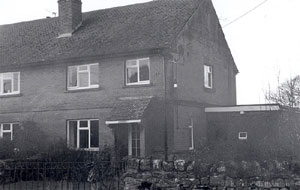
Forming the right-hand side of a brick building, the other half being Thornydale. The building is unusual in that it is built from brick in an area when all other buildings in the area are of stone construction apart from The Croft in Airton, The house was extended at the side to form a kitchen. Norcroft is owned by Ken and Sue Wright who lived there for many years with their three children before moving to live at Kirk Syke Farm in Airton. Norcroft and Thornydale were built post-war as farm workers cottages when each parish was required to provide housing for agricultural workers. |
||||
 |
Thornydale
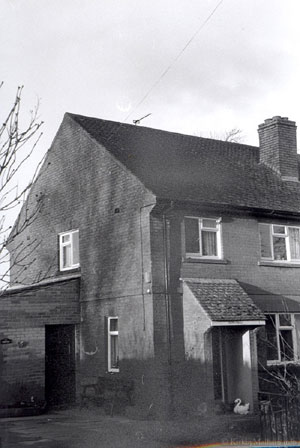
Forming the left-hand half of a brick building the other half being Norcroft. The building is unusual in that it is built from brick in an area where all other buildings are of stone construction, apart from The Croft in Airton, which was built in 19th century. Norcroft and Thornydale were built post-war as farm workers cottages when each parish was required to provide housing for agricultural workers. The house is occupied by Mr & Mrs Burrows. |
||||
 |
Kiln Hill.
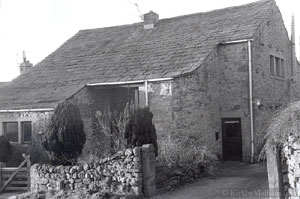
The barn was once part of the Calton Hall complex and is believed to have been built in the mid. 17th century. An extension at the back was added later. Kiln Hill was converted in 1981 to form one dwelling. A stone well was found in the rear of the building. It is currently occupied by Tony and Lorraine Dunn and their children. |
||||
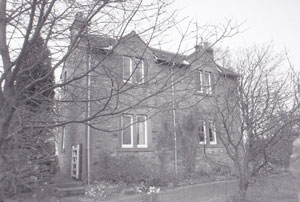 |
Croft House | ||||
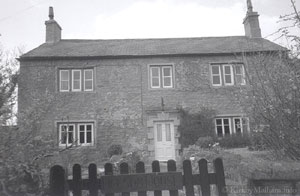 |
Nelson House.
Formerly known as The Rookery and before that as Kenmure House. The house which is grade ii listed was built between 1600 and 1650 by William Nelson who died in 1696. The house is of slobbered rubble construction with a slate roof at the front and a stone slate roof at the rear. The doorway is of particular note and features in “Doorways in the Dales” by Barbara Hutton and Joyce Martin, published 1986. It is described in the listed buildings register as having ‘probably mid 18th century gibbs surround, imitation keystones carved on the lintel, and cornice over’. Kirkby Malham church registers show that the Nelson family were firmly established in 17th century. Other known residents include John Morkill (14.7.1930), Luke Waite (1935), Edward le Fevre (1962), Barbara Fisher (1976), Thomas Paul (1980), Gordon Lennox and Maureen Learmonth (14.2.1984). The house was recorded by Yorkshire Vernacular Buildings study group on 4.11.1992, ref. No. 1400. 500 indigenous trees were planted in the croft in 1986. |
||||
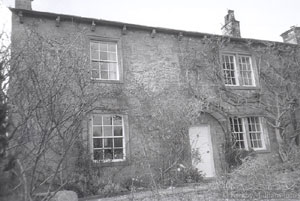 |
Calton Lodge.
17th century house with major developments undertaken in 1700 and 1860 when an ancient inglenook and beehive oven were removed. Slobbered rubble construction with stone slate roof. Main entrance to the left of centre has carved lintel with the initials I F I and two flower heads, possibly daisies. A mixture of windows including mullions and 19th century sashes. Calton Lodge was formerly known as Myrtle Cottage. The house is currently lived in by Norman and Margaret Simpson. |
||||
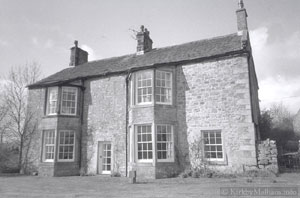 |
Calton Hall.
Is built on the site of an old and historic property dating back to 16th century when John Lambert bought the manor of Calton and the manor house, Calton Hall, in 1539. The manor house was in a bad state of repair, and following extensive repairs, the Lambert family made this their home. This John Lambert was great grandfather of General John Lambert (1619-1684) who was 2nd in command of the Parliamentary forces under Cromwell during the Civil War. In 1657 Lambert fell from favour with Cromwell and was deprived of all his offices and property. His estates were forfeited to Lord Fauconberg who later restored Calton Hall to the Lambert family and John Lambert, son of General Lambert took up occupation of the house. John Lambert, grandson of General Lambert, who was his last male heir, died only five months old in 1676 and is buried at Kirkby Malham. A brass inscription is still in the church. Most of the original hall was burnt down in the mid 1700’s and replaced to the western side by the current house. There are many traces left of the early mediaeval building: a stone fireplace on the first floor, a gothic doorway on the east wall and gothic window tracery, a draw well in the garden and the stone balls which cap the entrance gate, also the stoop of a sundial in the garden which bears the date 1688 with the initials J L. There are stables and a store house to the east of Calton Hall which were built in the mid to late 19th century in 17th century style. The stable has a wagon entrance to the left with four stalls and feeding troughs to the inside. There is a mounting block outside the main gate. Calton Hall is a Grade ii listed building in which the stables and store house are included for group value. Below is a copy of the details as listed of Calton Hall, courtesy of Craven District Council. |
||||
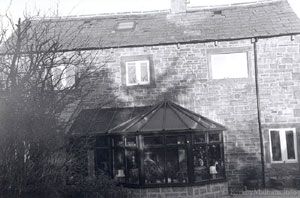 |
Hall Brow Barn.
Converted from a barn in 1985 to form one dwelling, the barn was once part of the Calton Hall complex. It is currently occupied by David and Nicky Crossley |
||||
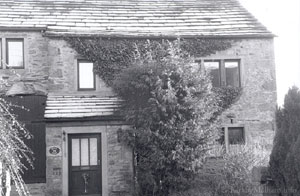 |
Hall Barn.
The house was converted from part of an ancient barn, possibly 400 years old, and was once part of the Calton Hall complex. The barn was converted in 1985 to form two houses, Hall Barn and Horseshoe Barn. Following conversion Hall Barn was occupied by Jo and Heide Duebelt and their daughter Jasmin. |
||||
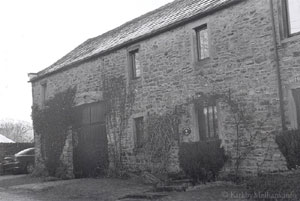 |
Horseshoe Barn .
The house was converted from part of an ancient barn, possibly 400 years old, and was once part of the Calton Hall complex. The barn was converted in 1985 to form two houses, Horseshoe Barn and Hall Barn. Timbers believed to be about 500 years old were recovered from the site during conversion. An ancient oak beam, now the lintel above the garage doorway, was believed to have come originally from Calton Hall. Horseshoe Barn is occupied by Geoff and Mo. Bryson. |
||||
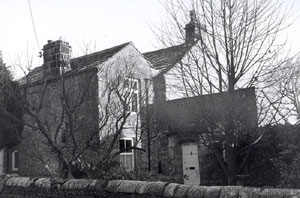 |
Calton Cottage.
Attached to Manor Cottage and dates from the 18th century it is thought to have been originally two cottages. It was a holiday cottage prior to 1983 and is currently lived in by Geoffrey and Pamela Waite. |
||||
 |
Manor Cottage.
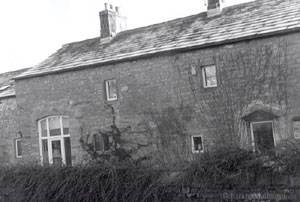
Attached to Calton Cottage and built in 18th century. Originally a ‘two-up two-down’ house and barn, the house was extended into the barn in 1912. Further extensions were made in 1988 and 1994. In 1852 the cottage was part of the estate purchased by William Alcock, banker, of Skipton. On 2.2.1901 Mr J.W. Morkill purchased the cottage from Alcock’s executors. Following that, on 29.12.1927, it was sold to James Woodhead. James Woodhead sold to Mrs Rebecca Sugden on 27.3.1927, the current owners’ grandmother. The house is now lived in by Frederick and Brenda Smith. |
||||
 |
Glendower | ||||
 |
Glendower Cottage | ||||
 |
Nelson Farm.
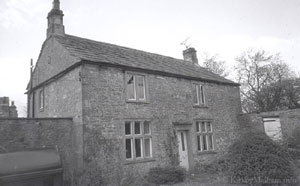
Farmhouse with 18th century garden front and 19th century rear wing forming a dairy and kitchen. The building is of slobbered rubble construction, brought to courses, with a stone slate roof. Inside there is a large 13 stone arched fireplace and a bread oven in the kitchen. Nelson Farmhouse and Glendower Cottage form the dwellings of the two farming families who farm the only remaining farm in Calton as dairy and sheep farming. |
||||
 |
Hill Top Cottage.
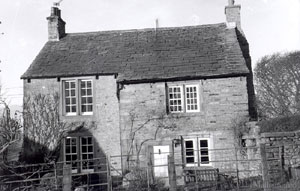
Built in the 17th century as one of a group of five small, ‘one-up one-down’, cottages on this hill top site. The cottages were believed to have been occupied by quarry-men or lead miners. One other remaining cottage, with upper storey removed, is now the outhouse shed to the south with a corrugated roof. The original bedroom fire-grate can be seen in the west wall of the shed. The original early 17th century cottage now forms the eastern half of the present house on to which was built the western half in about 1900. The ‘addition’ was constructed so that an unseen passage, about a metre wide, runs from north to south throughout the height of the building. Until 1958 Hilltop Cottage, together with Manor Farm and 3-4,000 acres of land to the north and south was owned by “The College of the Souls of all Faithful People Deceased” in the university of Oxford. It was rented for farming. In 1958 Hilltop Cottage was purchased by Mr G. Ewbank of Kettlewell and rented to Mr Carlisle and family, previously tenants of Nelson Farm, Calton. In 1967 Mr Ewbank sold Hill Top, with plantation and two-acre field, to the present owners Mr and Mrs K. Spencer. To the east of the front door are four stone shelves set into the garden wall and are understood to have been bee-boles. The tool shed in the south west corner was an outside privvy. An interesting wrought iron gate at the front entrance was made about 1963 by a Malham blacksmith. The property is held freehold except the small plantation to the rear of the present garage, which is a leasehold tenure for the residue of term of six thousand years created by a lease dated June 1609 and subject to a fee, farm or lords rent of fourteen shillings to the lord or owners of Calton Hall or other persons entitled to payments. |
||||
 |
Newfield Hall.
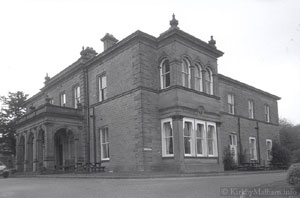
Built in 1850s by William Nicholson Alcock, barrister of the middle temple. William Alcock, who had been leasing Gisburn Park, took up residence in 1856. William died in 1876, and having no child of his own, left Newfield to his nephew William of Aireville, Skipton. William lived there for a while before moving to live down south. The census of 1881 shows no one living at the Hall. In 1890 he sold the Hall to William Illingworth, a wealthy worsted textile manufacturer, who in the 1891 census was 42 years of age. The hall was bought by John William Morkill in 1901. J.W. Morkill is renowned for his History of the Parish of Kirkby Malhamdale, published in 1933, from which much of this history is taken. Following Morkill’s death the Hall was sold to the holiday fellowship, a Christian Charity organisation, and has been used for holidays ever since. |
||||
 |
The Cottage, Newfield Hal l.
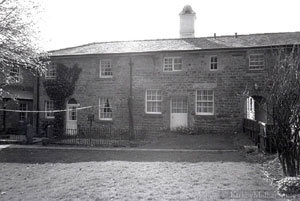
The Cottage forms part of the Newfield Hall complex and is situated at the back, access only through the hall grounds. The 1891 census shows this as being occupied by the gardener. |
||||
 |
Newfield Grange | ||||
 Malhamdale Local History Group